Five decisions, in the order they came
- Stop waiting to be found. Known: a new model, an unfamiliar alternative to talk therapy, and a board that expected good work to spread on its own. The question was how a grieving family reaches any program at all, and the answer was that someone refers them. It produced the referral map below, and it changed the president's job from watching the program to working the people who send families to it.
- Price the referral from the counselor's chair. Known: a referral happens in minutes, between other tasks, by someone who carries the blame if it goes badly. The question was what a yes cost that person, because that price, not our quality, set how often it happened. It produced the outreach order, with free, local and no waitlist in the first sentence and the board and the funders after it.
- Give funders and referrers one record. Known: grants and donations kept the program free. The question was whether the money and the reach were two efforts or one. They were one. A recognized grant tells a school that a third party has already looked at us, so the same governance and funding record went to a grant committee and to a counselor, and fundraising stopped being a separate track from outreach.
- Take the president off the Accountable line where a partner would look. Known: a new nonprofit starts with the president accountable for nearly everything. The question was what a partner could check about us, if they checked anything, and the answer was the money and what we said in public. The board took accountability for financial reporting and public communications, so the person raising the money was not also the only check on how it was reported.
- Work people, not institutions. Known: the referral decision is made by an individual counselor or coordinator, not by a district or a hospital system. The question was where to spend volunteer hours. The answer was individual relationships, and turning a first referral into a repeat one once a counselor had seen how the family was treated.
The referral map, as we worked it. The easy path runs down the fourth column. For the two people who actually send families, checking us cost nothing.
| Who decides | What a yes costs them | What makes it easy | What checking us would cost them | What the board supplies after the yes |
|---|---|---|---|---|
| A school counselor or administrator | A complaint, a liability question, extra work | Free, local, no waitlist, one sheet | Nothing, on the easy path | A clean public face and a board that answers for it |
| A hospice or care coordinator | Sending a family off the clinical default | The same three facts, said first | Nothing, on the easy path | The same record, plus the program's model in plain words |
| A funder or donor | Their money and their name | A clear use for the money | A real look at governance and reporting | Financial reporting the board signs, not only the president |
| The family | Showing up | A trusted adult already said yes | None; the referrer carried it | A program that is still free next time |
What it produced
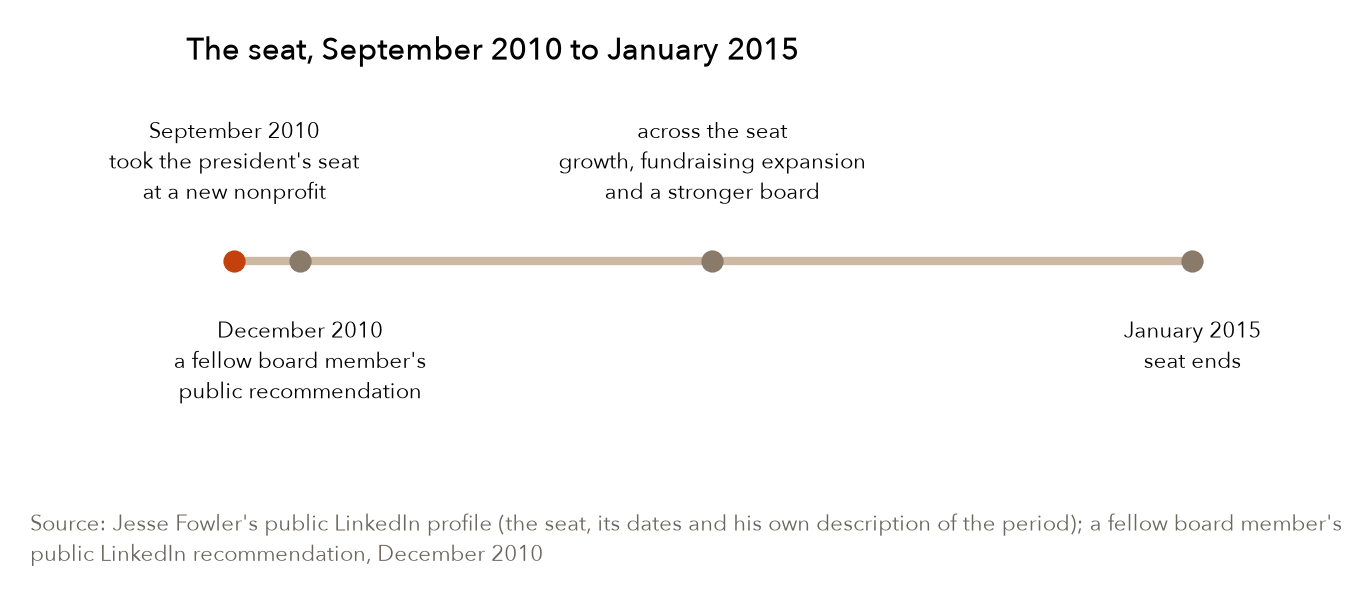
The seat ran from September 2010 to January 2015. Across it the organization grew, the fundraising expanded and the board took on more of the governance, which is the order you would expect if the outreach was working, since a board only has more to govern when there is more program to answer for. A fellow board member put her regard for the leadership in a public recommendation in December 2010. That is the outside word on the work, and it came early.
What I will not put here is a referral count, an enrollment figure or a grant total. The organization was small and volunteer-run, and I would rather show the shape of the work than dress an estimate as a measurement.
What we kept, and the default we took apart
We kept the program and its staff. The curriculum was not my job and never became it. The president's work was outside the room, with the people who send families into it.
We replaced the governance default. The RACI below is the one we ran, next to the one a new nonprofit starts with.
| Activity | Default: Accountable | What we ran: Responsible | What we ran: Accountable | Consulted | Informed |
|---|---|---|---|---|---|
| Grants and donor relationships | President | President | President, with board sign-off on larger grants | Board | Program staff |
| Financial reporting and board cadence | President | Treasurer or finance lead | Board | President | Donors and grantors, as the grants require |
| School and provider outreach | President | President | President | Program staff | Board |
| Public communications | President | President | Board | President | Schools and providers |
The default puts the president as Accountable on every row, and it exists for a good reason. In year one the president is the one person anyone can hold to anything, so a new board piles accountability there. The fault in that logic is that it works against the one thing a small, unfamiliar organization is selling to a referrer and a funder, which is that someone other than its most enthusiastic person is checking the work. When the same person raises the money and is the only check on how it is reported, the board is decoration. It had to change as the fundraising grew, because a larger grant is exactly the moment a funder, and after them a school, looks at who signs the reporting.
What we installed was the outreach order and that split. Neither is exotic. The point is that they were built as one system. The thing that made the first referral easy and the thing that made the second one safe were run by the same board.
The easy-yes test, before any referral pitch
- Name the person who actually says yes. It is rarely the end user.
- Write down what a yes costs them if it goes wrong, in their terms. A complaint, their name, their time.
- Strip out everything they would have to verify before saying yes, and put the facts that need no verification first.
- Put the credibility behind it, where they can find it after the yes. Who governs, who funds, who signs the reporting.
- Measure the second referral from the same person, not the first.
What it cost, and what I would watch
Leading with free has a price. It caps how much polish an organization builds up front, and a skeptic could fairly say it under-invests in credibility at exactly the moment a young organization has no track record to point to. Moving accountability to the board also cost the president control. The two rows a partner is most likely to check were no longer mine to sign alone, and on a volunteer board that means waiting on people who have day jobs. I thought both prices were worth it, and I still do.
What I would watch on any referral-driven service, nonprofit or not:
- The repeat referral. The first yes tells you the ask was cheap. The second yes from the same person tells you the work held up.
- Whether free stays free. The whole outreach order rests on the first sentence being true. If the funding slips and a fee or a waitlist appears, the easy path closes and nothing else in the pitch replaces it.
- Who signs the reporting. If the person raising the money is the only check on it, fix that before the larger grant, not after.
- The counselor, not the district. An agreement with an institution is not a referral. The person at the desk is.
The result, in short
I held the president's seat for four years and four months, September 2010 to January 2015, through a period the record describes as organizational growth, fundraising expansion and stronger board governance. The outside word came early: a board member's public recommendation in December 2010. No referral count, enrollment figure or grant total is printed; the organization was small and volunteer-run, and a shape is more honest here than an estimate dressed as a measurement.
A slice of the project list
A few related projects.
- Greensleeves Steakhouse: co-owner and operator, a landmark restaurant turnaround (2016 to 2022)
- Sublime Medical: fractional Chief Operating Officer, a medical aesthetics practice (2015)
- AXT Axe Haus: owner and operator of an axe throwing venue, entitlement fight and reopening (2018 to present)
- Habitat for Humanity: volunteer and board work (2007 to 2016)